


Customer complaints arrive through multiple unstructured channels including email, scanned letters, handwritten notes, branch-captured documents, and mailed correspondence. Each complaint must be manually opened, read, interpreted, categorized, and routed to the correct internal function (e.g., fraud, deposits, prepaid, ACH, card operations, disputes).
Manual review is time-consuming, inconsistent, and creates operational risk—particularly when complaints include complex identifiers such as account numbers, dates, SSN references, program names, intake notes, or third-party details. This slows downstream investigations, affects regulatory response times, and increases the risk of misrouted complaints, incomplete documentation, or untimely resolution.
Fisent BizAI Solution
BizAI automates end-to-end intake by reading and structuring information from complaints across any format, including typed letters, scanned PDFs, photographed documents, and handwritten text.
Using a field-extraction schema defined by the customer, BizAI identifies and normalizes key complaint data elements such as:
Customer Identity and Contact Data
First name, last name
Business name (if applicable)
Related party identifiers
Phone number
Email address
Full mailing address (street, city, state, ZIP, country)
Structured Output
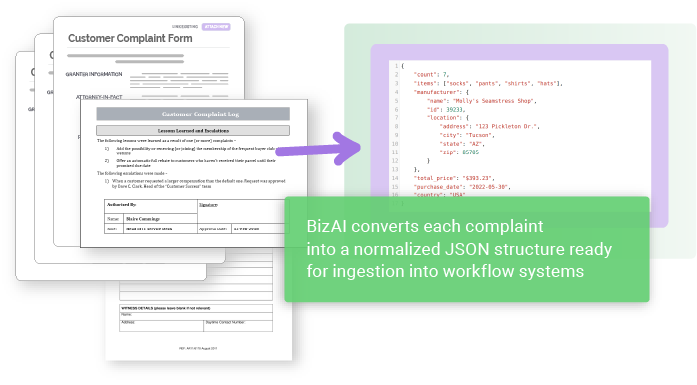
BizAI converts each complaint into a normalized JSON structure ready for ingestion into workflow systems
(e.g., Onspring, ServiceNow, internal case management workflows, etc.).
Business name (if applicable)
BizAI then classifies the complaint category and routes it to the appropriate operations team for investigation & ultimately resolution.
Financial Identifiers
Account numbers
(filtered to the Bank when required)
Card numbers
Related party identifiers
Program Analysis
Auto-classification into a dynamically provided list of 150+ program names (e.g., FinTech programs)
Complaint Metadata
Date of the letter
Complaint reason (summarized)
Contact notes
(secondary identifiers, DOB/SSN references, case no,, related parties)
Value Delivered
Reduced handling time
Cuts manual intake and classification from minutes per complaint to seconds
Higher routing accuracy
Ensures complaints reach the correct business function correctly the first time
Supports handwritten and low-quality input
Eliminates dependence on clean, structured digital formats
Regulatory compliance
Strengthens documentation quality and completeness for audits and complaint-response timelines with structured data outputs
Operational scale
Allows the bank to process large influxes of complaints without increasing staff
Data standardization
Produces clean, structured complaint records for downstream analytics and reporting
Mission Critical Process Automation
Regulated Industries Require a Robust Approach to Managing Customer Complaints